
For decades, weather forecasting has relied on a simple assumption: if you feed enough physics into enough supercomputers, you can predict the atmosphere.
A startup called WindBorne believes that assumption is incomplete.
Founded by Stanford dropout John Dean, the company has spent the last seven years building something unusual — a global network of autonomous weather balloons paired with proprietary AI forecasting models. The result is WeatherMesh 6, WindBorne’s latest forecasting system, which the company says now outperforms forecasts from the highly respected European Centre for Medium-Range Weather Forecasts (ECMWF) in parts of Europe and the United States.
If those claims continue to hold, WindBorne may represent a new model for AI companies: not just building smarter algorithms, but owning the infrastructure that generates the data itself.
A Weather Blind Spot Hidden in Plain Sight
Before founding WindBorne, Dean worked on Falcon 9 engine controls at SpaceX, autonomous driving systems at Lyft, and interned at NASA. During those experiences, he noticed something surprising.
The world’s weather observation network leaves most of the atmosphere largely unobserved.
Traditional weather balloons typically remain airborne for only a couple of hours before bursting. Oceans, polar regions, and remote areas receive sparse coverage despite being critical sources of storms and large-scale weather patterns.
According to WindBorne, this leaves vast portions of the atmosphere effectively invisible to forecasting systems. Dean’s solution wasn’t to build a better weather model first — it was to build better balloons.
Building a Global Sensor Network
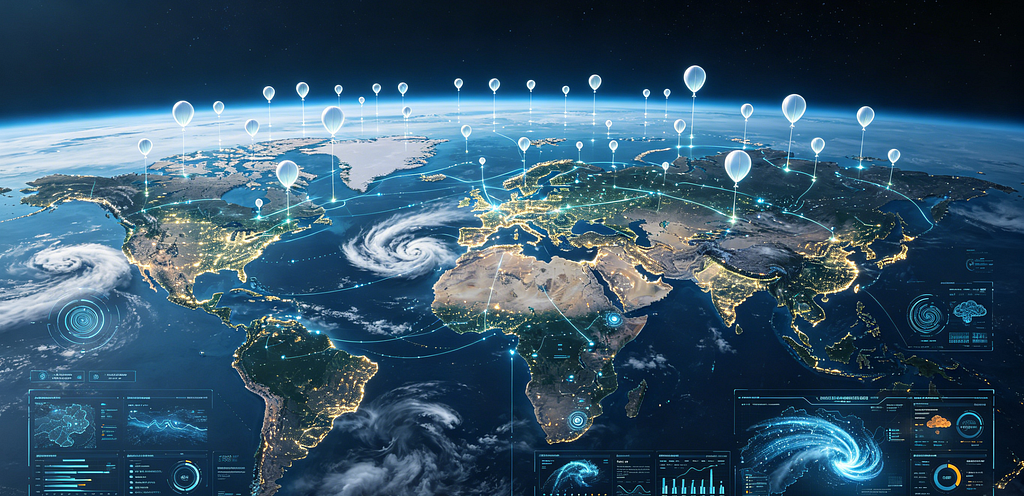
WindBorne developed its own Global Sounding Balloons (GSBs), lightweight autonomous balloons weighing less than 1.2 kilograms at launch.
Unlike conventional weather balloons that drift passively before failing after a few hours, GSBs can remain airborne for weeks. The company’s longest recorded flight lasted 75 days.
More importantly, the balloons can navigate by changing altitude and exploiting different wind currents, allowing them to move toward areas where new atmospheric measurements are most valuable.
Each balloon repeatedly travels between the surface and the stratosphere, collecting temperature, humidity, pressure, and wind data across multiple vertical layers of the atmosphere.
That data is transmitted via satellite and delivered within minutes.
Today, WindBorne operates roughly 400 active balloons across 15 launch locations worldwide. Its long-term goal is far more ambitious: a network of 10,000 balloons providing near-global atmospheric coverage.
Dean describes the vision as building “a nervous system for the Earth.”
Why Data, Not Models, May Be the Real Moat
The AI weather forecasting race has become increasingly crowded.
Companies worldwide are training AI systems capable of generating forecasts dramatically faster than traditional physics-based simulations. But most AI weather startups share a common dependency: they rely heavily on processed data from organizations such as ECMWF and NOAA.
That dependency creates a strategic problem.
While AI models may differ, they often begin with the same underlying datasets. As a result, competing systems frequently stand on the same foundation.
WindBorne chose a different path. Over the past year, the company redesigned its transformer-based forecasting architecture to ingest raw balloon observations directly, reducing its reliance on externally processed atmospheric analyses.
According to WindBorne’s engineering team, this direct-data approach became one of the key reasons WeatherMesh 6 achieved meaningful accuracy gains.
The company’s confidence is notable. Dean has publicly suggested that even without ECMWF data, WeatherMesh 6 would remain highly competitive because of the proprietary observations continuously flowing from its balloon network.
The Storm That Put WeatherMesh 6 to the Test
A major snowstorm in the northeastern United States earlier this year provided a real-world stress test.
The storm affected more than 40 million people across eight states, with hundreds of thousands of households facing potential power outages.
Six days before landfall, many traditional forecast models produced widely divergent scenarios. Some predicted a relatively weak system, while others placed the storm center far offshore.
Because ensemble forecasting often averages multiple scenarios together, extreme outcomes can become diluted. WeatherMesh 6 took a different view.
According to WindBorne, its ensemble forecasts identified a deep low-pressure system nearly six days in advance and accurately projected the storm’s path, intensity, and precipitation structure. Competing models largely converged on a similar forecast only two days later.
The advantage came from two design choices.
First, WeatherMesh 6 preserves extreme signals rather than smoothing them away through averaging. Second, the model updates forecasts every hour. Many major forecasting systems refresh only every six or twelve hours. By continuously incorporating incoming balloon observations, WeatherMesh 6 can rapidly adjust as atmospheric conditions evolve.
During the storm itself, forecast errors reportedly shrank from 146 kilometers to 88 kilometers within just five hours.
Turning Weather Into Infrastructure
WindBorne’s business strategy extends well beyond forecasting.
The company already sells atmospheric observations to NOAA, helping improve official U.S. forecasting systems. Its customers also include branches of the U.S. military.
Meanwhile, its forecasting products are used by commodity traders, hedge funds, and energy companies, where even a one- or two-day forecasting advantage can translate into significant economic value.
The company has raised approximately $25 million to date and is reportedly valued around $85 million. Yet Dean appears surprisingly uninterested in building a traditional consumer weather app.
His view is that future users may increasingly access information through AI agents rather than standalone software products. If that’s true, owning the underlying data infrastructure could become far more valuable than owning the interface.
The Bigger Bet
The most interesting part of WindBorne may not be its forecasting model at all.
In an era when most AI companies compete on algorithms, WindBorne is competing on data acquisition. Rather than treating sensors as someone else’s problem, it is building an entirely new observation network from scratch.
That approach echoes a broader lesson emerging across AI: models are becoming easier to replicate, but proprietary data remains difficult to copy. Weather forecasting has always been a race to understand an enormously complex system.
WindBorne’s wager is that the next breakthrough won’t come solely from larger models or faster chips — it will come from seeing more of the atmosphere than anyone else.