
In March 2026, a team of six students at MIT Media Lab built a project in just 48 hours that would eventually spark discussions far beyond the world of hackathons.
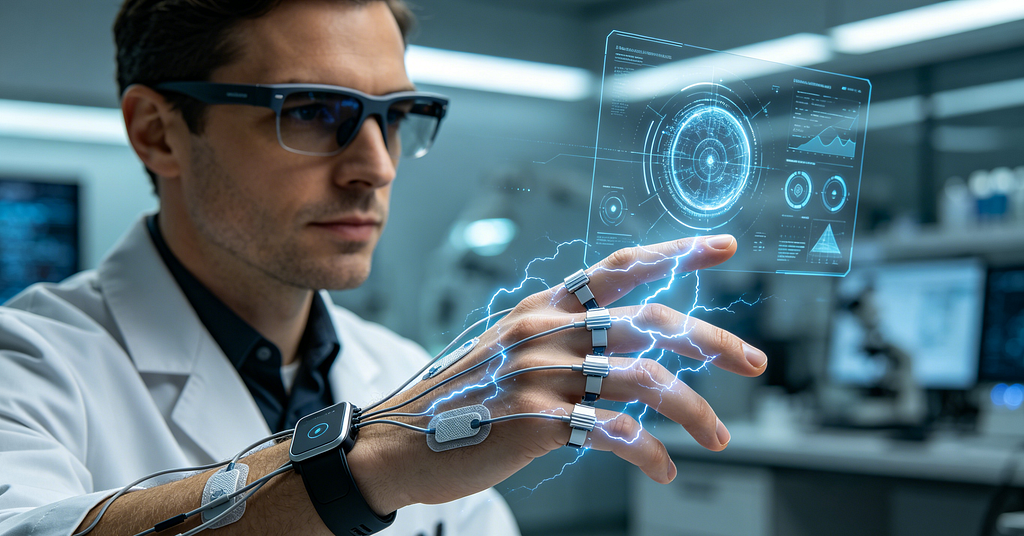
The project, called Human Operator, combined muscle stimulation, computer vision, and a large language model to create a simple but unsettling experience: you could tell an AI what you wanted to do, and it would physically move your hand for you.
What started as a student experiment quickly became an internet phenomenon. Social media users described it as “AI taking over the human body.” Others created AI-generated images imagining dystopian futures. Someone even launched a cryptocurrency inspired by the concept.
But according to team member Yutong Wu, the reality is far less dramatic — and arguably more interesting.
What Human Operator Actually Does
At a technical level, Human Operator is surprisingly straightforward.
A user speaks a command. Smart glasses capture a first-person view of the environment. An AI model analyzes the scene and generates instructions. An Arduino controller translates those instructions into electrical signals, which are then sent to EMS (Electrical Muscle Stimulation) electrodes attached to the user’s wrist and fingers.
The result? The user’s fingers move.
During demonstrations, the system played simple piano notes, made hand gestures, waved at people, and even drew the MIT Media Lab logo. The wearer wasn’t consciously initiating these actions. The AI generated the movement, and electrical stimulation triggered the muscles responsible for carrying it out.
Yet the system is far less powerful than many online discussions suggest.
“It helps you choose between a limited set of possible movements,” Wu explained. The project currently focuses only on fine motor control in the hand and wrist — not full-body control, and not even the entire arm.
In many ways, Human Operator is less of a mind-control device and more of a sophisticated multiple-choice interface for muscles.
The Real Innovation Wasn’t the AI
The internet focused on Claude, the large language model powering the system. But the AI itself was arguably the least novel part of the project.
EMS has existed for decades and is widely used in rehabilitation, sports training, and human-computer interaction research. The team’s inspiration came largely from the work of Pedro Lopes and the Human Computer Integration Lab at the University of Chicago, which has explored muscle stimulation as an interface for years.
The breakthrough came from connecting these existing technologies together.
Because the project was built during a hackathon rather than a formal research program, the students had the freedom to experiment with combinations that might face greater scrutiny in academic settings. They connected a modern multimodal AI model directly into the muscle-control loop, allowing the system to generate stimulation instructions dynamically based on what it saw.
That combination transformed a research concept into something that felt surprisingly futuristic. And importantly, surprisingly relatable. Everyone immediately understood the idea of an AI helping them play piano, mix drinks, or learn a physical skill.
What Does It Feel Like?
The most fascinating part of Human Operator may be the subjective experience. Wu described a strange split-second sensation between intention and action.
“There was a moment where my hand started moving before I consciously felt like I had decided to move it.”
That experience stems from how EMS works. Instead of sending signals through the brain’s normal motor pathways, electrical stimulation activates muscles more directly by targeting motor nerves.
The result isn’t quite mind control. It’s more like the body receiving an external suggestion that becomes movement. There are also built-in limitations. If a wearer actively resists the movement, discomfort quickly appears. The stronger the conflict between the electrical signal and the user’s intended motion, the more noticeable the resistance becomes. In practice, this creates a natural safety mechanism: the system cannot easily force someone to perform actions they strongly oppose.
Why the Internet Reacted So Strongly
The gap between what Human Operator does and how people reacted to it reveals something deeper about public perceptions of AI.
We’ve become accustomed to AI living on screens. AI writes text, generates images, answers questions, and helps with coding. Those interactions feel distant and abstract.
Human Operator crosses a different boundary. For the first time, many people saw AI influencing physical movement rather than digital output. Even though the system only controls a few fingers, it touches a deeply sensitive area: bodily autonomy.
That explains why the project generated such an outsized reaction compared to its actual capabilities. The viral narratives weren’t really about piano-playing fingers. They were about a future where AI becomes physically integrated with humans.
From Hackathon Project to Human Augmentation
Despite the attention, the team doesn’t view Human Operator as a near-term commercial product.
The hardware remains cumbersome. Electrodes need frequent replacement. Each user requires calibration. Factors like skin characteristics and body hair can affect performance. Turning the prototype into a consumer device would require significant advances in materials science and wearable design.
Instead, Wu sees greater potential in healthcare and rehabilitation. Future versions could potentially help stroke survivors relearn motor skills, assist patients with spinal cord injuries, or accelerate physical training by transferring expert movement patterns to beginners.
Imagine learning a musical technique not by watching a tutorial, but by physically feeling how an expert’s muscles move. That’s the long-term vision that interests the team far more than viral headlines.
Beyond the Hype
Human Operator’s story isn’t really about AI controlling people. It’s about what happens when AI leaves the screen and enters the physical world. The technology currently moves a few fingers across piano keys. That’s all.
But the reaction it triggered suggests that even small steps toward AI-human physical integration provoke questions far larger than the technology itself. Questions about agency, autonomy, learning, and the boundaries between human intention and machine assistance.
The project may have begun as a 48-hour hackathon experiment. The conversation it started is likely to last much longer.