
For most people, rising memory prices are an annoyance. For a YouTuber known as Dr. Semiconductor, they became an engineering challenge.
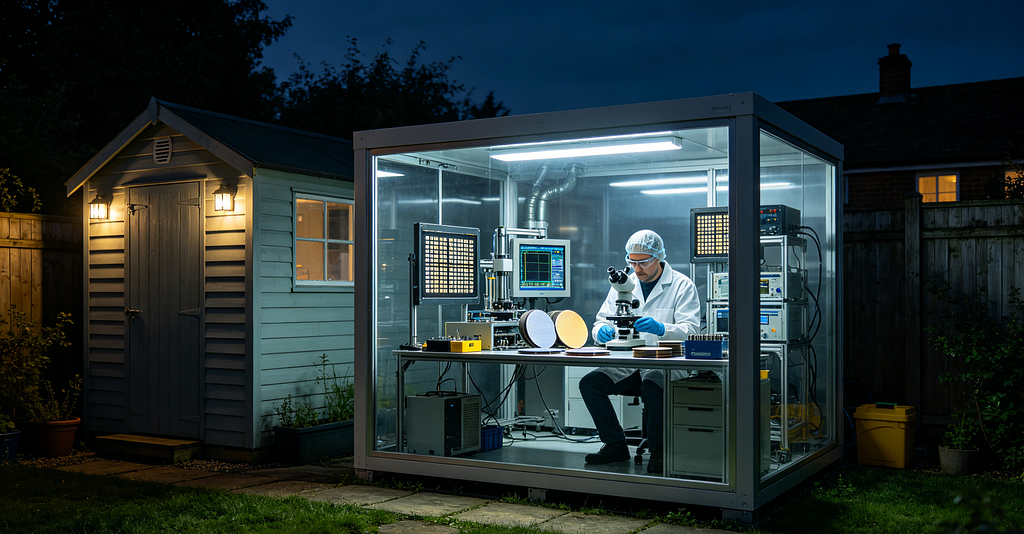
In a recently published video titled Making RAM at Home, the semiconductor enthusiast documented what may be the first publicly known case of an individual fabricating a functional RAM memory cell array outside an industrial cleanroom. The project wasn’t built in a university lab or a billion-dollar fabrication facility. It was built in a homemade cleanroom inside a garden shed.
The result was modest by modern standards: a working array containing just 20 memory cells. Yet the achievement has captured the attention of hardware enthusiasts worldwide because it demonstrates something remarkable: semiconductor manufacturing, while extraordinarily difficult, is no longer entirely inaccessible to individuals.
Building Memory Is Harder Than It Sounds
Modern DRAM is one of the most sophisticated products humanity manufactures.
A standard DRAM cell consists of a transistor and a capacitor. Conceptually, it’s simple. The capacitor stores electrical charge, representing a binary 1 or 0, while the transistor controls access to that charge.
The challenge lies in scale.
Today’s commercial memory chips are built using process nodes measured in mere nanometers. Producing them requires precision deposition systems, photolithography equipment, ion implantation tools, and fabrication facilities that can cost between $10 billion and $20 billion to construct.
Dr. Semiconductor wasn’t trying to replicate Samsung or Micron’s manufacturing process. Instead, he worked at a much larger micron-scale geometry, creating memory cells with capacitors roughly 1,000 times larger than those found in modern DRAM.
In practical terms, his homemade RAM is closer to the technology of the early 1970s than anything you’d find inside a modern PC. Yet that’s precisely what makes the project impressive.
A Chip Fabrication Line Built at Home
The process involved many of the same fundamental steps used in commercial semiconductor manufacturing.
First came wafer preparation. Silicon substrates were cut, cleaned, and prepared for processing. Next, the wafers underwent oxidation inside a homemade furnace, creating a thin insulating layer before being coated with photoresist.
Using ultraviolet lithography, patterns were projected onto the wafer surface and chemically developed, transferring the circuit design onto the silicon. In the semiconductor industry, lithography is often considered the heart of chip manufacturing because it defines nearly every feature on the final device.
The second stage involved transistor fabrication. Through multiple cycles of etching, doping, and thermal treatment, conductive regions were formed inside the silicon substrate. The process required precise control of temperature, timing, and chemical concentration — mistakes often meant starting over from scratch.
Finally came metallization. Aluminum connections were deposited onto the chip through custom masks, creating complete memory cells capable of storing and retrieving charge.
The finished device contained only 20 cells, but testing confirmed that it functioned as genuine RAM. That’s a long way from running modern software. As Dr. Semiconductor joked in the video, it’s nowhere near capable of running DOOM. But that’s not really the point.
The Bigger Story Isn’t the RAM
The most fascinating aspect of the project may actually be the infrastructure behind it.
Months before producing the memory array, Dr. Semiconductor documented the construction of a homemade cleanroom using HEPA filtration, positive-pressure airflow, and anti-static materials. The setup reportedly achieved approximately Class 100 cleanliness — far from the standards of leading semiconductor fabs but sufficient for micron-scale fabrication.
The project reflects a broader trend that has been quietly growing over the past decade: the democratization of chipmaking knowledge.
One of the best-known examples is Sam Zeloof, who began building integrated circuits in his parents’ garage while still in high school. His work eventually led to increasingly sophisticated chips and later the founding of Atomic Semi.
Dr. Semiconductor’s work extends that tradition into memory technology, which presents a different set of challenges. Unlike logic circuits, DRAM relies heavily on capacitor quality and charge retention. Even minor leakage can render a memory cell useless.
That makes a functional homemade DRAM array particularly noteworthy.
The Real Achievement
Nobody expects backyard fabrication projects to compete with companies like Micron Technology, Samsung Electronics, or SK hynix.
The significance lies elsewhere.
For decades, semiconductor manufacturing has been viewed as one of the most capital-intensive industries on Earth, requiring immense budgets, specialized facilities, and armies of engineers. This project doesn’t challenge that reality — but it does suggest that parts of the process can be explored, understood, and even replicated by determined individuals.
The homemade RAM won’t change the memory market. But it serves as a reminder that some of the most interesting engineering breakthroughs begin with curiosity, persistence, and someone asking a seemingly unreasonable question:
“What if I just built it myself?”